
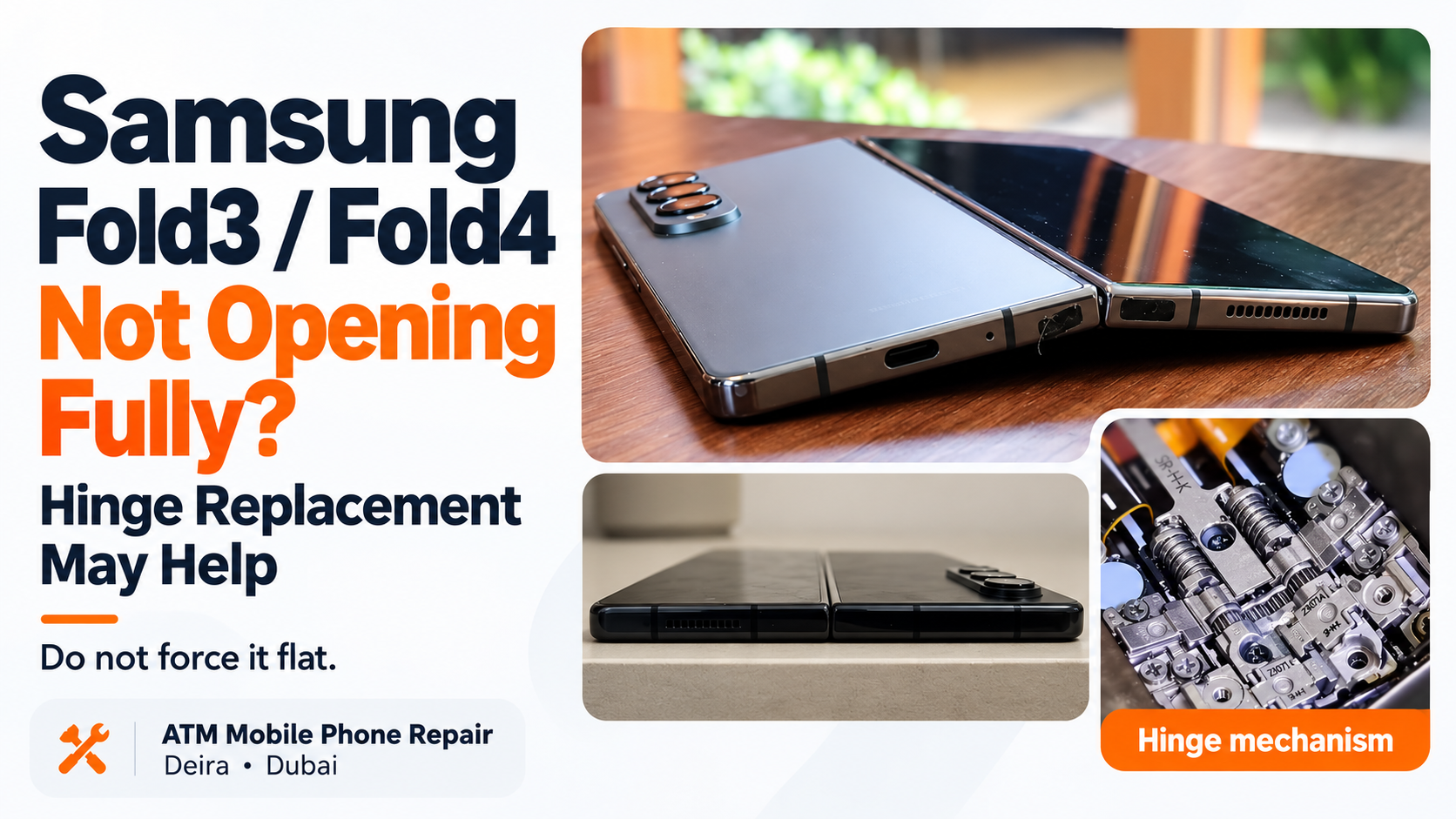
Does your Samsung Galaxy Z Fold3 or Fold4 stop opening at around 160° or 170°? A hinge problem may prevent it from unfolding flat. Learn what to avoid and when hinge replacement can help.
Samsung Fold3 or Fold4 Not Opening Fully? Hinge Replacement May Help
Your Samsung Galaxy Z Fold3 or Z Fold4 used to unfold flat, but now it stops at around 160° or 170°. The screen may still work perfectly, yet the phone remains slightly bent when opened.
You may feel resistance near the hinge or notice that the opening angle has gradually reduced.
This can indicate a hinge obstruction or mechanical fault. It does not automatically mean the inner display needs replacing.
At ATM Mobile Phone Repair in Dubai, we repair suitable Galaxy Z Fold3 and Fold4 devices by replacing the faulty hinge. We first inspect the hinge, frame and display to confirm the appropriate repair.
Why Does the Phone Stop Opening Fully?
The hinge controls how the phone’s two halves move and supports their alignment during folding.
If something obstructs the mechanism, or its components become damaged or misaligned, the phone may no longer reach its normal fully open position.
Possible causes include:
Debris inside the hinge area.
Damaged or displaced internal hinge components.
Impact damage around the hinge.
A bent or misaligned frame.
Problems following a previous repair.
The opening angle alone cannot identify the exact cause. A phone stopping at 170° may have a different underlying problem from another phone with the same symptom.
Can Dust or Sand Affect the Hinge?
Yes. Small particles can interfere with a foldable phone’s moving parts.
Samsung identifies the Galaxy Z Fold3 and Fold4 as IPX8-rated models and warns that exposure to particles such as sand may affect hinge operation and device performance. Water resistance should not be mistaken for protection against dust or grit.
However, not every stiff hinge is caused by dust. Mechanical damage and alignment problems also need to be considered.
Do not assume that cleaning the visible hinge surface will resolve an internal obstruction.
Is This the Same as Flex Mode?
No. Holding the phone partly open intentionally is different from being unable to unfold it fully.
Foldable phones are designed to stay at certain intermediate angles for activities such as watching videos or taking photographs.
The concern is when the phone previously opened flat but now reaches a firm stopping point, feels unusually stiff or no longer moves normally.
Do not try to overcome that resistance by applying more force.
Why You Should Not Force It Open
When a hinge stops moving normally, forcing the phone flat can place additional stress on the frame, flexible display and nearby connections.
A mechanical problem can become more complicated if other components are damaged during repeated attempts to straighten the phone.
Avoid:
Pushing hard on both halves to reach 180°.
Pressing down on the centre of the inner screen.
Twisting the phone.
Repeatedly opening and closing it to “loosen” the hinge.
Inserting paper, blades, pins or other objects into hinge gaps.
Applying oil, lubricants or cleaning liquid inside the hinge.
If the phone will not open normally, stop at the point of resistance and arrange an inspection.
Does the Inner Display Need Replacing?
Not always.
A phone can have a faulty hinge while its inner display still produces a clear image and responds correctly to touch.
If the display remains suitable for reuse and the device’s condition allows it, hinge replacement may restore normal movement while retaining the existing screen.
However, a separate display repair or replacement may be needed if inspection reveals:
Cracks in the folding area.
Black patches or damaged pixels.
Permanent lines.
Touch failure.
Damage to the display’s connections.
A hinge replacement addresses the mechanical fault. It does not repair an already damaged display panel.
How Hinge Replacement Can Help
When the hinge is confirmed to be faulty, replacing it can address the obstruction, stiffness or abnormal movement caused by that assembly.
At ATM Mobile Phone Repair, our approach is to assess whether a separate hinge replacement is suitable before recommending a larger repair.
The work involves careful disassembly, replacement of the faulty hinge and reassembly with attention to alignment.
Depending on the replacement part supplied and the phone’s condition, the repair may also involve associated frame components. The exact scope should be explained in the quotation.
The aim is to restore normal opening and closing—not simply make the phone look flatter.
Why Is This a Specialist Repair?
The hinge sits close to delicate parts, including the folding display and flex cables.
Accessing it can require extensive disassembly. A working screen must be handled carefully, particularly if the phone has suffered impact, frame distortion or previous repairs.
Keeping the original display is the preferred outcome when it is suitable, but successful reuse cannot be promised before inspection. Existing damage can affect both the repair method and the risk involved.
This is why hinge replacement should be assessed by a technician experienced with foldable devices.
What Do We Check Before Recommending the Repair?
The inspection considers:
Opening and closing behaviour: Where movement stops and whether resistance is uneven.
Hinge condition: Visible dents, damage or abnormal movement.
Frame alignment: Whether either half is bent or distorted.
Inner display: Image quality, touch response and existing damage.
Related symptoms: Flickering, black-screen behaviour or other faults during normal movement.
Repair history: Previous disassembly, impact or liquid exposure.
These checks help determine whether hinge replacement alone is appropriate or whether additional work is required.
What Happens After Hinge Replacement?
After assembly, the device needs to be checked for smooth movement and correct alignment.
Relevant checks include:
Normal opening and closing without forcing.
Frame and panel fit.
Inner and outer display operation.
Touch response.
Screen switching when folding and unfolding.
Any functions affected by the disassembly.
A phone opening fully is only one part of confirming a successful repair.
Can You Continue Using the Phone?
If the phone otherwise works, back up your important data while it remains accessible.
Minimise unnecessary folding and avoid pushing beyond its comfortable opening range. If the outer screen works normally, it may provide temporary access while you arrange an inspection.
Seek prompt attention if you notice worsening resistance, new noises, screen lifting, lines, black patches or loss of touch.
If the phone becomes unusually hot or shows swelling, stop using and charging it until it has been assessed.
How Much Does Fold3 or Fold4 Hinge Replacement Cost?
The price depends on:
Whether the device is a Fold3 or Fold4.
The condition of the hinge and frame.
Whether the existing display can be retained.
The replacement assembly required.
Any additional damage found.
The expected turnaround also depends on parts availability and the work involved.
Send us your exact model and a brief description of the issue. A final quotation can be confirmed after inspection. If you already have a photo showing the restricted opening angle, you can share it—there is no need to force the phone open for a picture.
Samsung Fold3 and Fold4 Hinge Repair in Dubai
If your Galaxy Z Fold3 or Fold4 stops opening at around 160° or 170°, do not force it to reach 180°.
A hinge fault may be responsible, and a full display replacement may not be necessary.
ATM Mobile Phone Repair in Deira – Al Murar, Dubai, offers hinge replacement for suitable Samsung Galaxy Z Fold3 and Fold4 devices.
We inspect the device, explain whether the existing display can be retained and confirm the repair options before proceeding.
Restore normal folding with the right repair—not extra pressure.
Was this article helpful?