
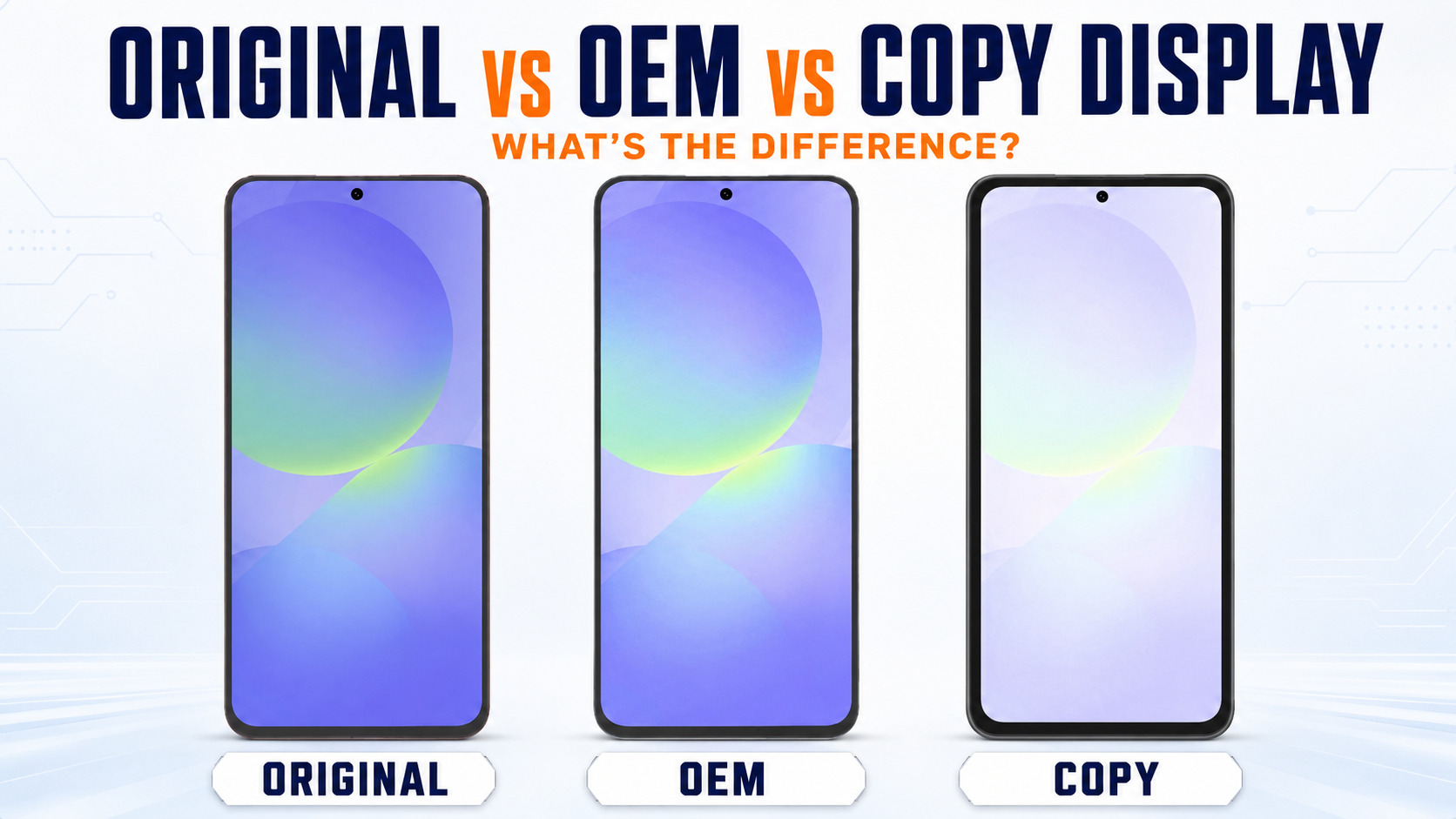
Choosing a replacement phone screen can be confusing. Learn the differences between original, OEM and copy displays, including their effects on brightness, touch response, battery life, heating and durability.
When replacing a broken phone screen, you may be offered an original, OEM, refurbished or copy display. These terms can be confusing, and they are not always used consistently in the mobile-phone repair industry.
The cheapest display may appear attractive, but screen quality affects much more than appearance. It can influence touch response, brightness, battery backup, operating temperature, fingerprint recognition and the phone’s overall reliability.
Before approving a repair, it is important to understand exactly which type of display will be installed.
What Is an Original Display?
An original display is produced for the phone manufacturer and designed specifically for that model. A genuine manufacturer service-pack display is generally the closest replacement to the screen originally fitted to the phone.
Original displays normally provide:
Accurate colours High maximum brightness Smooth touch response Correct screen resolution Proper refresh-rate support Better outdoor visibility Efficient power consumption Correct fit and thickness Better durability Support for compatible display features
Some original service-pack displays are supplied with the phone’s frame already attached. This can provide a more precise fit and reduce the possibility of installation problems.
Original displays are normally the most expensive option, but they are usually recommended for premium devices, newer phones and customers planning to keep their phones for a long time.
What Is an Original Pulled Display?
An original pulled display is removed from another phone of the same model. The display itself is genuine, but it is not new.
Its condition depends on the donor phone and may include:
Small scratches Previous impact damage Age-related wear Weak adhesive or frame damage
A carefully tested original pulled screen can perform better than a low-quality copy.
What Is a Refurbished Original Display?
A refurbished original display normally uses the phone’s original LCD or OLED panel, but its damaged outer glass has been replaced.
If the refurbishment has been completed properly, it may retain much of the original screen’s:
Colour quality Resolution Brightness Touch sensitivity Power efficiency Refresh rate
The final quality depends heavily on the glass, adhesive, touch layer and refurbishment process. Poor refurbishment can cause touch problems, dust under the glass, lifting edges or reduced durability.
A high-quality refurbished original display can provide a good balance between price and performance.
What Does OEM Display Mean?
OEM stands for Original Equipment Manufacturer. Technically, it refers to a company that manufactures components used in the original product.
However, the term “OEM” is frequently used loosely in the repair market. Some suppliers use it for a genuine manufacturer display, while others use it to describe a premium aftermarket screen.
An “OEM-quality” display is not necessarily an original display.
The exact type of screen is more important than the word “OEM” printed on its packaging.
What Is a Copy Display?
A copy display is manufactured by a third-party company rather than being supplied as a genuine manufacturer replacement.
Copy screens are available in many quality levels. Some premium aftermarket displays provide acceptable performance, while very cheap copies may have noticeable limitations.
Possible differences include:
Lower brightness Less accurate colours Reduced resolution Slower or inaccurate touch response Poor viewing angles Lower refresh rate Thicker construction Larger screen borders Weak glass Poor frame alignment Reduced outdoor visibility Faster battery drain Increased heat Compatibility problems with phone features
A copy display may be suitable for an older or low-value phone when the customer needs the most economical repair. However, its limitations should be explained clearly before installation.
Can a Copy Display Cause Phone Heating?
A copy display can sometimes make a phone warmer, particularly when it uses less efficient display technology or poorly designed control electronics.
For example, some phones are originally designed with an OLED display, but a low-cost replacement may use LCD technology. An LCD requires a continuously powered backlight, while an OLED lights individual pixels only when needed.
The copy display may also use lower-quality driver components that consume more power. This increased electrical demand can contribute to:
Extra heat during normal use Faster battery drain Reduced battery backup Higher power consumption at maximum brightness Faster battery discharge while watching videos or gaming
However, not every copy display will cause overheating. Phone heating can also be caused by:
A weak or damaged battery Background applications Charging problems A faulty charger Software issues Poor mobile-network signal Motherboard faults Incorrect display installation
If heating begins immediately after a screen replacement, the display and its installation should be inspected.
Why Can Battery Backup Become Lower?
The display is one of the largest power-consuming components in a smartphone. If a replacement screen requires more current than the original, the phone’s battery will discharge faster.
Battery backup may be reduced because of:
An LCD replacing an original OLED panel An inefficient display backlight Low-quality display-driver circuits Incorrect automatic-brightness operation Higher brightness needed because the screen is difficult to see A defective display or flex cable Electrical leakage from a poor-quality component
A battery that previously lasted all day may begin requiring more frequent charging after a low-quality screen replacement.
This does not happen with every aftermarket display, but it is more common with very cheap or incorrectly specified screens.
Other Problems Associated With Copy Displays Poor Touch Response
Low-quality touch layers may cause delayed response, missed touches or random input. Typing and gaming can become especially difficult.
Reduced Brightness and Colour Quality
Copy displays may look dim outdoors, and colours may appear washed out, overly blue or unnatural.
Lower Refresh Rate
A phone originally designed for a 90Hz or 120Hz display may not feel as smooth if the replacement screen cannot reproduce the correct refresh rate.
Fingerprint Sensor Problems
Phones with an under-display fingerprint sensor may not recognise fingerprints reliably when fitted with an incompatible or low-quality display.
Sensor and Calibration Issues
Depending on the phone model, a replacement display may affect:
Automatic brightness Proximity sensing Colour calibration True Tone or similar features Touch sensitivity Always-on display functions
Some models require programming, calibration or data transfer from the original display.
Reduced Durability
Cheap copy screens may use weaker glass or poor-quality frames. They can crack more easily, lift from the frame or develop touch and display problems after minor impact.
Risk to Display-Related Circuits
A defective screen or damaged display flex cable can create unstable electrical behaviour. In serious cases, this may place additional stress on the display power circuit or motherboard.
Original vs OEM vs Copy Display Comparison Feature Original Service Pack OEM/Premium Aftermarket Copy Display Source Manufacturer-approved supply Depends on supplier terminology Third-party manufacturer Display technology Matches the original Usually similar, but confirm May use a different technology Brightness and colours Closest to factory quality Generally good Often lower or less accurate Touch response Excellent Usually good Quality can vary Refresh rate Correct model specification May support the correct rate May be limited Battery efficiency Designed for the phone Usually acceptable May consume more power Fingerprint and features Best compatibility Model and quality dependent Compatibility problems are possible Fit and durability Usually the best Generally good Can vary significantly Price Highest Mid-range Lowest Which Display Should You Choose? Choose an Original Display If: Your phone is new or valuable You want the closest factory-quality result Display brightness and colour accuracy are important You use the phone for gaming, photography or professional work You plan to keep the phone for a long time Battery efficiency and full feature compatibility are priorities Consider a Refurbished Original or Premium Aftermarket Display If: You want a balance between price and quality A genuine service-pack display is too expensive The screen comes from a reliable supplier The repair centre provides a clear warranty All important features can be tested before completion Consider a Copy Display If: The phone is old or has a low resale value You need a temporary repair Your budget is limited You understand the possible quality differences The price and warranty are clearly explained Questions to Ask Before Replacing Your Screen
Before approving the repair, ask:
Is the replacement OLED or LCD? Will the original refresh rate be supported? Will the fingerprint sensor and other features work? Could the display affect battery consumption? Does the display include a frame? What warranty is provided? Can I test the brightness, touch and colours? Will the phone be resealed after installation?
A professional repair centre should answer these questions clearly rather than relying only on terms such as “OEM quality.”
What About Water Resistance After Screen Replacement?
Opening a phone breaks its factory sealing. A technician can install new adhesive and reseal the device, but the original water-resistance rating cannot always be guaranteed after repair.
The quality of the replacement frame, adhesive and installation process can affect how securely the phone is sealed.
Even after a professional screen replacement, avoid intentionally exposing the phone to water.
Final Thoughts
An original display normally provides the best brightness, touch response, battery efficiency, durability and compatibility. A high-quality refurbished original or premium aftermarket display may offer a good balance between cost and performance.
Copy displays are more affordable, but their quality varies considerably. A low-quality copy screen may cause poor touch response, reduced brightness, incorrect colours, fingerprint problems, increased battery consumption and additional heat—especially when an LCD is installed in a phone originally designed for OLED.
ATM Mobile Phone Repair can inspect your phone and explain the available display options before replacement. We can help you compare original, refurbished and aftermarket screens so you can choose the most suitable option for your device and budget.
Was this article helpful?