
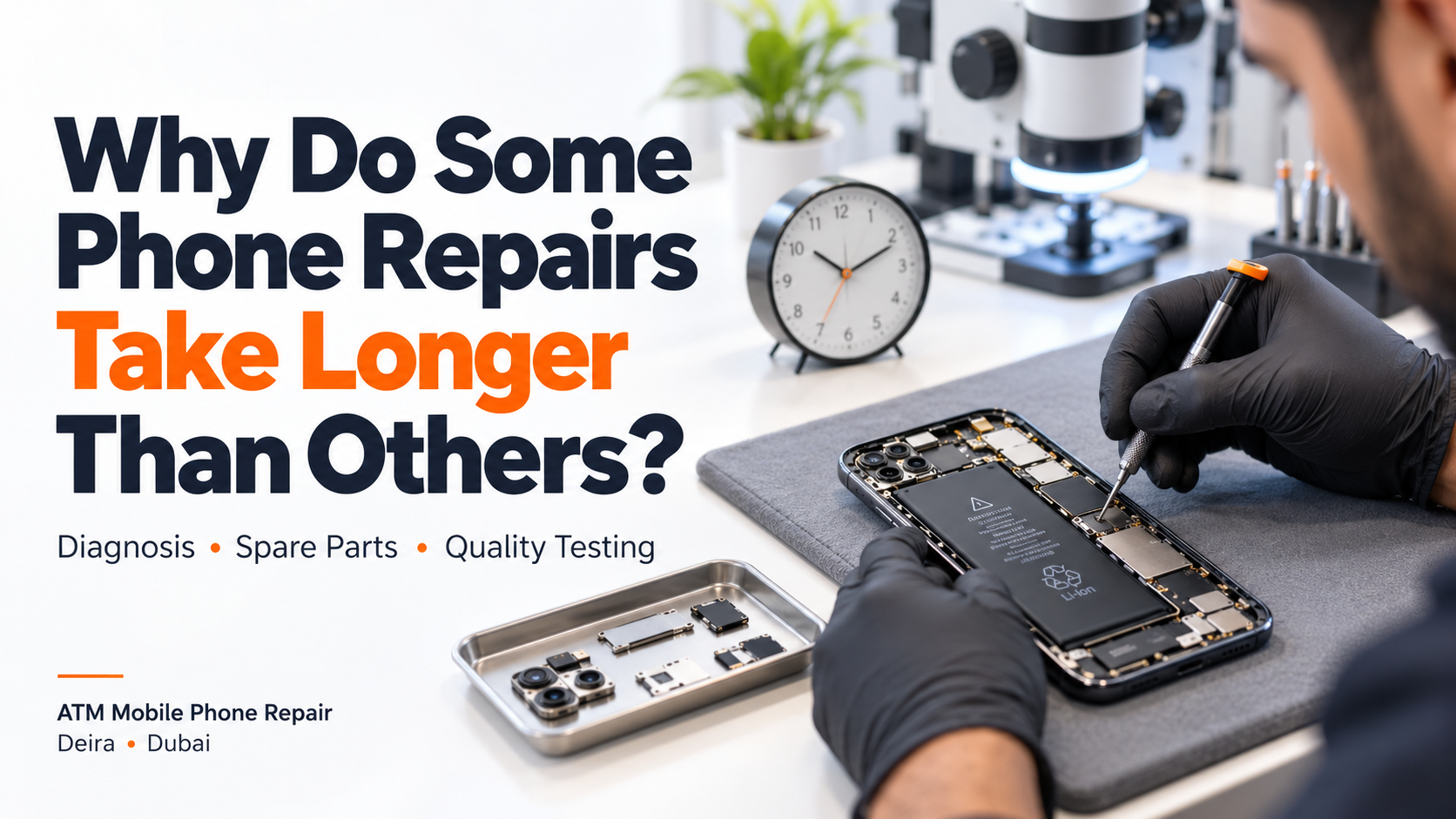
Some phone repairs can be completed quickly, while others require extra diagnosis, specialised parts or careful testing. Learn what affects repair time and why a longer turnaround does not always mean a more serious fault.
Why Do Some Phone Repairs Take Longer Than Others?
When you hand over your phone for repair, one of your first questions is usually: “When will it be ready?”
Your phone keeps you connected to family, customers, work and important accounts. Being without it—even for a short time—can be inconvenient.
However, not every repair follows the same process. A straightforward replacement with an available part may be completed quickly. An intermittent fault, motherboard problem or overseas spare-part order can take considerably longer.
Repair time depends on identifying the fault, getting the correct part, completing the work and confirming that the phone operates reliably.
1. Finding the Fault Can Take Longer Than Replacing the Part
A visible symptom does not always reveal its cause.
A phone that does not charge, for example, may need more than a charging-port replacement. The technician must first determine which part of the charging system is responsible.
Similarly, a blank screen does not automatically mean the display needs replacing.
Replacing parts without confirming the fault can lead to unnecessary costs and repeat repairs. Diagnosis helps the technician recommend the right work before proceeding.
Some faults are easy to reproduce. Others appear only occasionally, making them harder to confirm.
2. Spare-Part Availability Makes a Big Difference
Even when the problem is clear, the correct replacement part may not be immediately available.
Repair centres commonly keep frequently used parts in stock. However, stocking every component for every phone model, version and colour is difficult.
A part may need to come from:
A local supplier.
A specialist parts distributor.
An overseas supplier.
A source supplying less common or discontinued components.
A small component can cause a longer wait than a large one if it is harder to source.
For example, a display available locally may be replaced sooner than an uncommon fingerprint sensor that needs to be ordered.
3. The Correct Colour and Version Matter
Two parts that look similar may not be suitable for the same repair.
Depending on the component, the technician may need to match the exact model, hardware version, connector arrangement or exterior colour.
This is particularly relevant for visible parts such as:
Fingerprint buttons.
Back panels.
Frames and housings.
Camera surrounds.
Foldable-phone trim pieces.
A repair centre may have a compatible part in gold while the customer’s phone requires green. Using the wrong colour could leave an obvious mismatch.
Waiting for the correct part can help preserve the phone’s original appearance.
4. Overseas Orders Add Delivery Time
When a suitable part is unavailable locally, overseas sourcing may be necessary.
The waiting period can include supplier processing, dispatch, international shipping, customs clearance and local delivery.
These stages are separate from the actual repair work. A phone may spend most of its turnaround time waiting for a part, even if installation takes much less time.
An estimated arrival date is also different from a confirmed delivery date. Shipping delays can affect the original estimate, so clear updates are important.
5. Foldable Phones Require Careful Work
Fold and Flip phones contain delicate displays, hinges, flex cables and closely fitted internal parts.
Depending on the model and repair, reaching one faulty component may require removing several other components first. The technician must assess the surrounding frame and hinge as well as the reported problem.
A replacement cable, for example, may not provide a lasting solution if damaged surrounding parts continue to place stress on it.
The size of a replacement part does not show how much work is needed to access and install it.
This is one reason a seemingly small foldable-phone repair can take longer than expected.
6. Motherboard Repairs Involve Several Stages
Motherboard work is different from replacing a complete screen or battery.
The process may involve inspecting the board, taking measurements, locating a fault, repairing it and then checking whether normal operation has returned.
Sometimes the first repair restores power and makes further testing possible. Only then can the technician assess functions that could not be checked while the phone was dead.
If another issue is discovered, the repair scope and completion estimate may need to change.
A responsible repair centre should explain significant findings and obtain approval before carrying out additional chargeable work.
7. Previous Damage Can Complicate the Repair
A phone may arrive with more damage than is visible from outside.
During disassembly, the technician may discover corrosion, damaged connectors, missing brackets, previous soldering work or a bent frame.
For example, a new display may not sit correctly in a damaged housing. The frame may need attention before the device can be assembled properly.
These findings can add time because the repair centre must assess the problem, discuss the options and possibly source another part.
8. Customer or Insurance Approval May Be Pending
Sometimes a repair is waiting for authorisation rather than technical work.
This may happen when:
The original quotation has not yet been approved.
The customer needs to choose between available part options.
Additional damage changes the estimate.
An insurance provider or service partner must authorise the repair.
Customers may assume work started when the phone was received. However, chargeable repairs generally begin only after the required approval.
It helps to distinguish between “awaiting approval,” “waiting for parts” and “under repair.” Each status explains a different reason for the delay.
9. Testing Continues After Installation
Installing the replacement part is not always the final step.
Before returning the phone, the technician needs to check the repaired function and other relevant features.
Depending on the job, this may include testing:
Display quality and touch response.
Charging and battery behaviour.
Fingerprint registration and unlocking.
Calls, microphones and speakers.
Cameras and sensors.
Normal opening and closing on a foldable phone.
A phone that works immediately after installation may still need further observation if the original fault was intermittent.
“Repair completed, under quality check” means the work has been done, but final testing is still in progress.
10. Intermittent Problems Need Extra Observation
Some faults do not appear every time the phone is used.
A device may restart only occasionally, lose touch response after extended use or stop charging unpredictably. If the problem does not occur during the first check, more testing may be necessary.
The technician also needs to see whether the repair has actually resolved the reported behaviour.
When handing over the phone, explain when the issue occurs and provide a short video if you already have one. A clear description can make diagnosis easier.
Does a Longer Repair Time Mean Poor Service?
Not necessarily.
A longer turnaround may reflect careful diagnosis, uncommon parts or additional testing. However, the repair centre should explain the reason clearly.
Good communication should tell you:
What stage the repair has reached.
What is causing the wait.
Whether anything is needed from you.
Whether the original completion estimate has changed.
You should not have to guess whether your phone is waiting for a part or still being tested.
How Can You Help Avoid Unnecessary Delays?
Before handing over your phone:
Back up important data if the device is accessible.
Describe the problem clearly, including when it started.
Mention previous repairs, drops or liquid exposure.
Provide the exact model information when requesting a quotation.
Respond promptly to approval requests.
Explain any urgent deadline before work begins.
Agree on how testing that requires unlocking will be handled.
If a particular colour or part quality matters to you, confirm it before the spare is ordered.
What Should You Ask About the Turnaround Time?
Useful questions include:
Is the required part currently in stock?
Does the estimate include sourcing and delivery?
Does the turnaround start from approval or device receipt?
Is the estimate in calendar days or working days?
Is additional diagnosis required?
Will I be contacted if the completion date changes?
These questions help set realistic expectations from the beginning.
Phone Repair With Clear Updates in Dubai
Some phone repairs are quick because the fault is straightforward and the correct part is available. Others take longer because of diagnosis, parts sourcing, careful disassembly or quality testing.
At ATM Mobile Phone Repair in Deira – Al Murar, Dubai, we explain the proposed repair, available parts and expected turnaround after assessing the device.
If your phone is urgently needed, let us know when you contact us. We can check the available options and give you a realistic estimate based on the work required.
A good repair should come with both careful workmanship and clear communication.
Was this article helpful?